The Hour That Belongs Nowhere
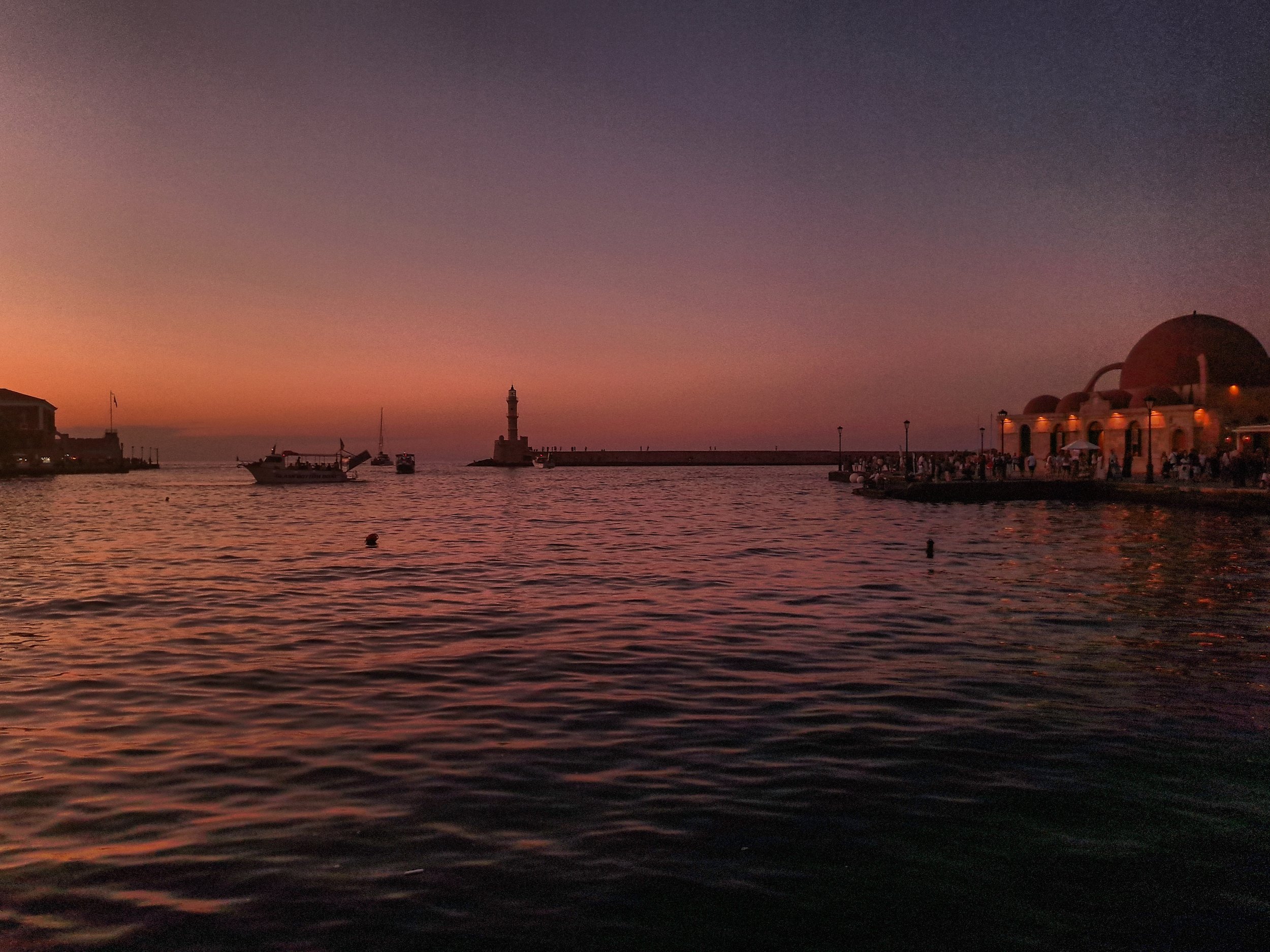
The hour that belongs nowhere
And there are certain moments that could only be described as transitional. Unusual. Different.
Moments that can change you, shape you, and, at the same time, test you. Moments you cannot wait to end, and others you cannot wait to begin. And then there are moments that seem to belong to a larger system — a system built around shifts, transitions, and handovers.
But let me explain.
I was at the Venetian Harbor in Chania, taking photographs, when I realized that this particular hour was slowly handing the baton over to the night.
It wasn’t quite daylight anymore, but it wasn’t night either. It existed somewhere in between — in that strange interval where you can no longer clearly separate day from night, light from darkness, joy from sorrow, health from illness.
Instead, you begin to notice colors, shapes, and reflections on the water. Orange, turquoise, sky blue, purple — and whatever else the sky decides to reveal.
And if you look closely enough, perhaps you begin to see something of yourself reflected there too.
Do you want to work late? Go home and rest? Go out? Stay a little longer? Return from your walk?
This particular moment, contrary to what we often assume, belongs nowhere.
As a liminal moment — difficult to describe, unruly, unpredictable — it refuses to fit neatly into a category. Of course, meteorology can give it a name and a precise time. But philosophically? Practically? Emotionally?
Not quite.
The rhythm of the day gradually gives way to the rhythm of the evening. The city changes shifts. Some people finish work while others begin. Some head home; others are only now stepping outside. Restaurants fill, lights switch on, glasses are poured, conversations grow louder, and the streets begin to acquire another personality.
The same city is still there.
And yet, somehow, it is no longer quite the same.
I sometimes ask myself: if this moment belongs nowhere, then what exactly is the point of enjoying it?
Perhaps the answer is precisely that it belongs nowhere.
There is something strangely appealing about existing between categories. About belonging somewhere and nowhere at the same time.
I may come from Thessaloniki, for example, but I am also European. I can feel connected to one place without being imprisoned by it. One identity does not necessarily cancel another. We can carry several worlds within us without having to choose which one is the “real” one.
Perhaps time works in much the same way.
Perhaps we can simply enjoy this hour without constantly asking how, where, when, or why.
Without overthinking it.
Without overanalyzing it.
We can simply take photographs. Kiss. Laugh. Walk. Sit beside the sea. Hug someone. Watch the light disappear. Stay for five minutes longer than we had planned.
And when that invisible boundary is finally crossed and night falls, we surrender — sometimes willingly, sometimes mercilessly — to our fears, our desires, and all the things that become louder when daylight disappears.
Until morning arrives again.
The so-called “normal” day.
And eventually, against the same backdrop, this hour will return. Only it will never really be the same. The light will be different. The people will be different. We will be different.
Still, we photograph it.
Perhaps because we want to keep something that cannot be kept.
Perhaps because we know, somewhere inside us, that the moment will disappear regardless of whether we are ready to let it go.
And maybe this is when we finally realize that the time which “belongs nowhere” exposes something much larger: time itself is, at least partly, a human construction. A language we created to communicate, organize, meet, work, leave, return, and understand one another.
The sky does not care whether it is 8:17 or 8:23.
The sea does not check the clock.
The sun does not become anxious because it is running late.
They simply change.
And within those magnificent colors — somewhere between the sun and the moon, between what has ended and what has not yet begun — real life continues.
Perhaps that is why I love this hour.
Because, for a brief moment, the “musts” begin to surrender to the “wants.”
At least for some of us.
And for those for whom this is not yet true, perhaps this hour offers something else: an invitation.
An invitation to change.
To question how much of our life is built around what we must do and how much around what we genuinely want to do.
Because maybe the hour that belongs nowhere is not empty at all.
Maybe it is precisely there — in the space between one thing and another — that we are most free to decide what comes next.
