Deep melancholy
Deep melancholy
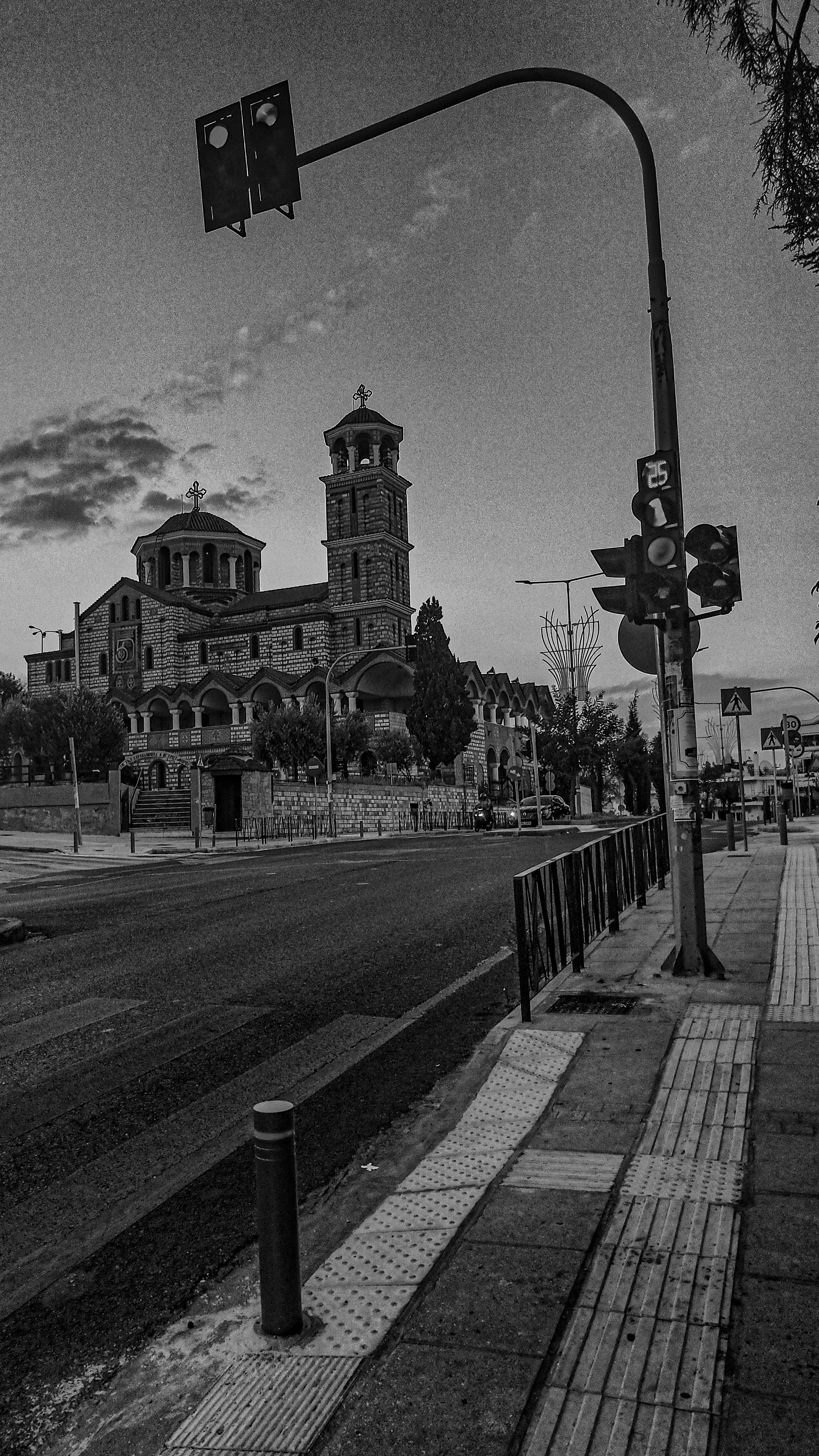
At first glance, the photograph appears to be black and white. Dark. With a deep sense of dystopia, gloom, and sorrow. Despite the fact that a sacred temple surrounds it, people are mourning inside it.
They see people leaving, people arriving, people becoming believers or non-believers. They change their positions, they change their faith, they change their very lives.
The signs, neatly arranged in a row, show cars and passersby where to go. They maintain an order, a mythical guidance, based on human law.
On the poles, you see papers from funerals—for people who have passed away—but also from weddings—relationships and systems being born. Families being built, lineages coming to life.
The road? It shows that we can all cross it—and indeed, we must cross it ourselves so that it becomes our own path: lawful, ethical, and above all, our own. But the sidewalk, too—our comfort zone—is fine.
And now that I’ve explained what I see in the image, before I wrap up this text, I’ll tell you why I photographed it in the first place. The subject isn’t the church, the street, the funerals, or the signs. It’s the traffic light of life.
Submerged in red—the “stop,” that deeply melancholic, anticipated halt—people wait. They remain in a state of anticipation, in a state of eager action. And they wait, wait, wait. Until they see the red.
And most people, because of the color, give up. And they wait for the light to turn green—they wait and wait, but nothing happens. And so, they abandon their dreams.
Running a red light isn’t the answer. It leads straight to a dystopia. That’s why there’s a timer up there. Did you notice it?
And that is hope.
It is joy.
It’s courage.
And when the light turns green, the action begins. When the light turns green, that’s when we start taking action. We love. We talk. We dream. We live.
But that timer over there will warn us when the red light comes on, too. And then, we’ll put our lives on pause. Until the green light comes back on—or maybe the yellow, in an in-between state.
But who said that melancholy is hidden in the red? Who said that the melancholy of the text is hidden in funerals, death, the church, or the red? They were wrong.
Melancholy lies in the fact that we expect only green in our lives.
Melancholy lies in the fact that we aren’t living our lives.
Melancholy lies in the existence of colors, not in the traffic light.
Because, after all, our lives are free. With morality and love for our fellow human beings, we don’t need to wait for the “right moment” or the right opportunity. We don’t need to predict our future—we need to create it.
That, after all, is the very reason the road exists. Now, why are there traffic lights on it?
I don’t know. All I know is that this text isn’t about traffic lights. It’s about stale dreams. Melancholic dreams. Dead dreams…
